
Your Database's Real User Might Not Be You Anymore
On Neon, 80% of new databases are created by an AI agent, not a person. That one stat explains a wave of billion-dollar deals, and it should change how you design a schema.
Gabriel Santos
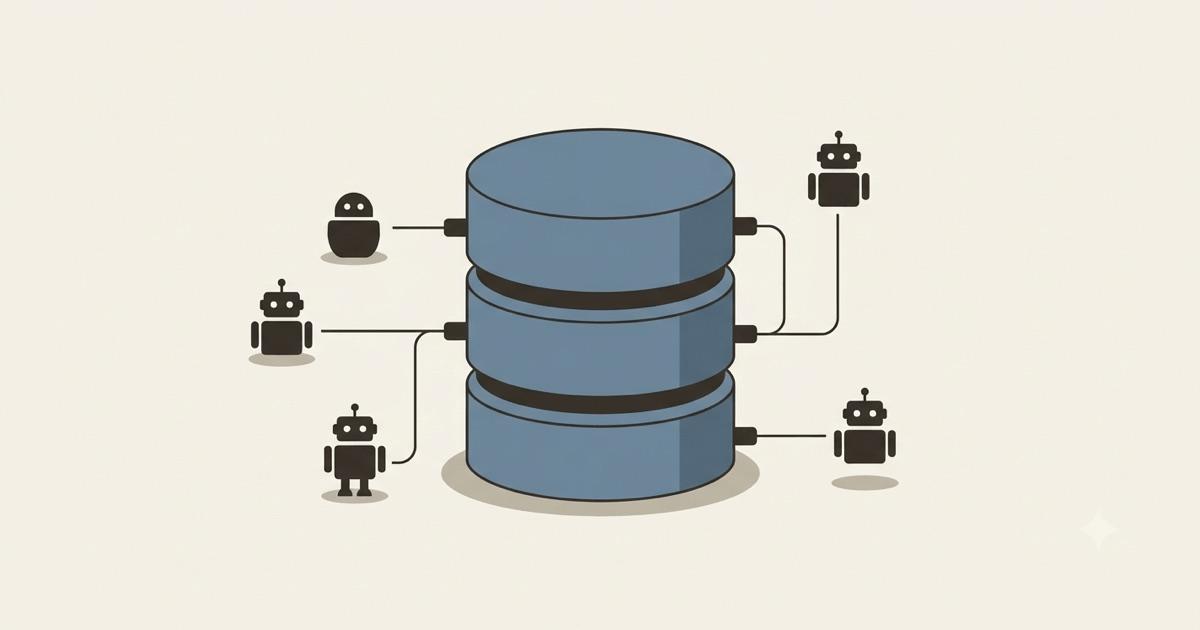
Here is a number that should stop you mid-scroll: on Neon, 80% of new databases are created by an AI agent, not a person clicking "create database". A year ago that number was 30%. That single stat is reportedly why Databricks paid roughly a billion dollars for Neon, and once you see it, a string of unrelated-looking database deals suddenly reads as one story.
The pattern behind the deals
- Databricks bought Neon, serverless branchable Postgres, for about a billion dollars
- Supabase raised 500 million at a 10.5 billion valuation, citing 600% year over year growth in database creation, over 60% launched by AI tools like Bolt.new, Lovable, Cursor, and Claude Code
- PlanetScale brought the Drizzle ORM team in-house to fund a stable 1.0
- MongoDB shipped automated embeddings for Atlas Vector Search straight into the platform instead of leaving it to application code
None of these are AI feature press releases. They are infrastructure bets on who, or what, actually provisions and queries a database now.
This changes what "good schema design" even means
When a human designs a schema, the constraint is usually clarity for the next developer. When an agent is provisioning databases live, in response to a prompt, the constraint flips. The platform has to make good defaults nearly automatic, because there is no code review catching a missing index or an unbounded table before it hits production. That is a genuinely good explanation for why serverless, branchable Postgres and built-in vector search stopped being nice-to-haves. The platform has to be the safety net a human reviewer used to be.
What this means for how you build
You are still the one who understands your domain, your data model, your query patterns, no agent replaces that judgment, and I would not want it to. But the tools you reach for are increasingly built for a world where provisioning and iteration happen fast and often, sometimes with zero humans in the loop. Vector search as a first-class database feature, not a bolted-on add-on, is now a reasonable default if you are building anything AI-adjacent. Judge your next database pick on how well it survives fast, frequent, sometimes automated schema changes, not on how it performs under one carefully planned migration you did by hand. Your database's real user might not be you anymore. Are you designing for it?